Work is the leading source of stress in daily life. That was true before hybrid and remote work reshaped how people spend their days, and it remains true now — in some respects more so, because the boundaries between work and rest have become harder to maintain.
For employers, this creates a straightforward responsibility: the environment you provide, and the programmes you build around it, directly affect how your team performs. Workplace wellness is not a perk. It is an operating condition.
What is the Definition of Wellness?
Wellness involves incorporating daily healthy habits into our lifestyle. According to the World Health Organisation (WHO), health is defined as “a state of complete physical, mental and social well-being and not merely the absence of disease or infirmity.”
Applied to the workplace, that definition covers three dimensions: physical health, mental health, and social connection. A complete wellness approach addresses all three, not just the most visible one.
Why Should Businesses Welcome Wellness Programmes?
Research consistently shows that organisations implementing workplace wellness programmes develop more inclusive cultures with workforces that are more motivated, engaged, and productive. The benefits translate into measurable outcomes: higher revenue, reduced healthcare costs, and decreased absenteeism.
Sophie Stainton of GO Mammoth puts it directly: “There is a recognition of a direct correlation between a fit and healthier team, and high performance and productivity.”
Employees who report good physical and mental health at work are more present, more focused, and less likely to leave. The cost of replacing a skilled employee typically exceeds the cost of investing in their wellbeing by a significant margin.
Despite this, fewer than one in ten employees worldwide have access to workplace wellness programmes. The gap between what the research recommends and what most businesses actually do remains wide.
Which Wellness Programme is Right for Your Business?
There is no single answer. The right programme depends on your team’s size, work style, and the specific pressures they face. What follows is a framework across the three core dimensions.
1. Physical Wellbeing
Regular physical activity is one of the most evidence-backed interventions available. Exercise boosts morale, reduces anxiety and depression, improves cognitive function, and increases energy levels.
As sports psychotherapist Gary Bloom explains: “During exercise, increased heart rate means more oxygen is pumped to the brain and other organs too. Since the brain thinks we are going to fight an enemy or run away, it secretes endorphins which give us a feel-good factor.”
Practical options for employers include subsidised gym memberships, on-site fitness facilities, standing desks, and encouraging walking meetings. For businesses based at SOHO Malta, an on-site gym is included in membership as standard, not as an add-on.
2. Mental Wellbeing
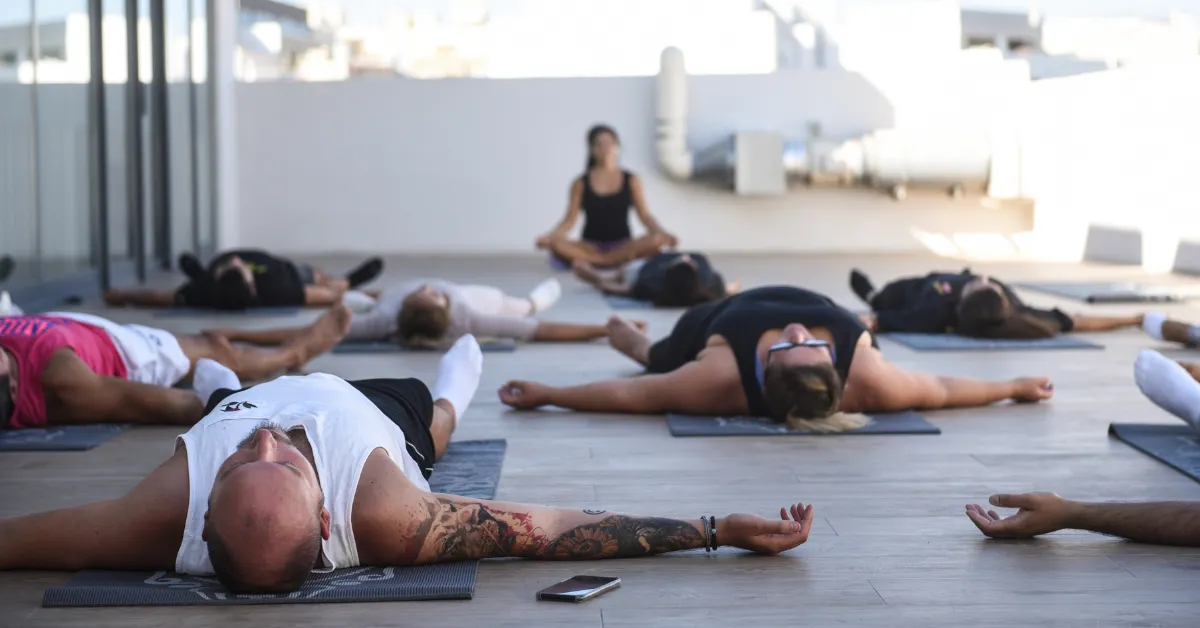
Mental health support at work starts with the basics: designated spaces to decompress, reasonable workload expectations, and a culture where stress is acknowledged rather than ignored. Beyond the structural, two programmes with strong evidence bases are yoga and sauna therapy.
Yoga: Regular practice offers documented benefits across stress management, anxiety reduction, brain function, energy, back pain, sleep quality, and cardiac health. The evidence holds regardless of fitness level or experience.
Sauna therapy: Research by Christopher Minson (University of Oregon), Christopher Lowry (University of Colorado), and Tanjaniina Laukkanen (University of Eastern Finland) demonstrates that sauna use affects serotonin levels, the principal hormone regulating mood and wellbeing. Benefits include lower blood pressure, relief from chronic pain, improved sleep, and mood stabilisation. As cardiologist Rita Redberg of UCSF notes: “Time in the sauna is time well spent.”
SOHO Malta’s locations include yoga classes and sauna access for members. See the community page for current schedules.
Note: consult a physician before beginning any new physical activity programme.
3. Social Wellbeing
As David Taylor, Director of Pharmacy and Pathology at the Maudsley Hospital, observes: “Humans are social animals, whose mental health depends upon frequent interaction with others and the outside world.”
In a work context, social wellbeing means more than having colleagues nearby. It means belonging to a group that meets, shares ideas, and maintains a life outside of individual task completion. Employers can support this through structured events, shared spaces, and community programmes.
SOHO Malta runs SOHO TALKS, a regular event series for entrepreneurs and business owners covering topics from business growth to industry trends. For members, it provides a regular reason to connect with Malta’s wider business community.
In Summary: The Benefits of a Workplace Wellness Programme
A well-designed programme produces:
- A healthier, more resilient workforce
- Higher employee loyalty and retention
- Greater engagement with the work itself
- Stronger recruitment of skilled candidates
- Measurable productivity and ROI improvements
Healthy employees are better equipped mentally and physically to execute tasks efficiently and at a higher level. The investment pays back in output, in retention, and in the culture you build.
What Are the Main Steps to Set Up a Wellness Programme?
- Conduct employee assessments — find out what your team actually needs before choosing a programme
- Select a programme based on those assessments — physical, mental, social, or all three
- Develop goals and wellness rewards — set clear outcomes and recognise participation
- Allocate a budget — even modest investment delivers returns
- Implement the plan — start with one or two initiatives, measure impact, then build
The Workspace Itself is a Wellness Factor
One thing most wellness frameworks underplay: the physical environment where your team works every day is not separate from the wellness conversation. It is part of it.
A workspace with natural light, adequate space, and separation from home life produces measurably better outcomes than a cramped or isolating environment. For businesses looking to provide their team with a workspace designed around these principles, SOHO Malta’s Dedicated Desks include access to all wellness facilities — gym, yoga, sauna, and social spaces — as part of the membership.
The simplest wellness programme you can offer your team is a workplace that supports them by default.